Has it really been over a month since I last posted?!?! Sigh....
Losing a parent at a very young age, as I did, has curious consequences throughout the course of one's life. F'rinstance, today, the Sunday of the Last Judgement. If you read all the liturgical texts, Vespers and Matins as well as Liturgy, the predominant word is "fear" (well, "fear and trembling"), and rightly so, when one considers that this is It -- there are no more chances to make good whatever we so skillfully screw up. You're either a sheep or a goat, and no in between.
This awareness does absolutely nothing to me.
Back in the Stone Ages, when I attended school, the nuns of St. Margaret's were constantly harping on this theme of Living Each Day as Though It Were Your Last. Maybe it scared the living daylights out of every other kid in the class, I don't know. What I felt, in a seven-year-old, 1952 kind of way, was, "Well, that's a no-brainer." I had that down cold by the time I was three years old, having lost my father at age two. Of course every day could be your last day. How could you ever be sure of anything? How brain-dead did you have to be, not to get that notion squared away?
Then there is the awareness of being condemned to hell for eternity. Well, yes, this is not something I would want to happen, but it still doesn't terrify me as it probably should. God is God, He can do whatever He wants. If despite all my good efforts He still decides that my sins cancel out everything I've tried to please Him, what're you gonna do? So there's no point worrying about that.
However...it grieves me, in this present life, that despite my best intentions, I still sin. I still drop the ball. I still choose other things over God. Terror over not spending eternity in heaven, or even with God, doesn't bother me; grief does. I would like to spend just one day of my life, before I die, not grieving God, and the knowledge that this is probably not ever gonna happen really pains me. I will still keep trying, of course. I will still keep worshipping God, since even the worst sinner still has that obligation, so being the chief of sinners doesn't let me off that hook. Nor would I want it to; that's not a hook I intend ever to let go. I will still make the very best effort I can to live a Christ-like life, because that's what I'm all about; and if, at the end, it wasn't enough, then so be it.
At least when I die, I will lose the ability to sin. And that's a relief.
Sunday, February 26, 2006


Monday, January 23, 2006
The Surikov Diaries: I
It occurs to me that it might be worthwhile to keep a sort of journal about the Boyarina Morozova, which I just started on Sunday. Nothing too grand, just my impressions of the project while I stitch it. Things like when I finish page 1, page 2, all the way down to page 75 -- oh, BTW, I realized after my last post that the reason it has 75 pages is that it has a lot of white space, and clear gridding every single page, which the program I have at home doesn't have -- if it did, the cross stitch I'm doing for my son might be 30 pages, not just 15.
With that in mind, I began, as stated, on Sunday, January 22. Never mind the fact that I've had this pattern since December 2004. It takes courage to start something this big. As of today, I have 200 stitches on it, which sounds impressive till you realize that the thing is almost 200,000 stitches, and takes up the better part of a 3' x 5' piece of linen. So far, it's very green. Green is not a color I normally associate with winter, but as I look at what I've done, it occurs to me that despite such undeniably summery names as Ivy Green and Thyme Green, it's all actually very cold-looking -- and Arctic ice often appears greenish. I'm in the upper-left-hand corner, by the way, and what I've been stitching is very dark sky. I'm hoping that as I add more greys, the sky will look less greenish and more like a lowering storm sky that threatens snow. As if there weren't already enough in this painting.
Something this size is best worked on a large, large frame -- or sideways. I've opted for the latter. I have it rolled up on a 36" stretcher bar, and plan to progress down one complete side before moving back to the top to stitch the next 8 sections (8 pages of pattern compose a side). So the pattern will go from top to bottom, but not show very much of the subject matter at first -- once the first 8 pages are done, you should be able to see most of the young lady on the far left who's gasping in sympathetic horror, but not much else. I do plan to update this blog with photos, but since I don't have a digital camera (and wouldn't know how to link it up to my computer if I did), I plan just to take a series of pictures with a disposable camera, then post the best to each blog. So there will be a whole lot of updates at once, I'm afraid -- but it's the best way I can think of to handle this. My first pictures are of the first 100 stitches in the frame, and shows something of my work set-up (if it all comes out -- I haven't had too much luck with photographing my needlework. The light's always either too much or too little).
More to come.... /insane cackling, as organ music swells, then fades out....
With that in mind, I began, as stated, on Sunday, January 22. Never mind the fact that I've had this pattern since December 2004. It takes courage to start something this big. As of today, I have 200 stitches on it, which sounds impressive till you realize that the thing is almost 200,000 stitches, and takes up the better part of a 3' x 5' piece of linen. So far, it's very green. Green is not a color I normally associate with winter, but as I look at what I've done, it occurs to me that despite such undeniably summery names as Ivy Green and Thyme Green, it's all actually very cold-looking -- and Arctic ice often appears greenish. I'm in the upper-left-hand corner, by the way, and what I've been stitching is very dark sky. I'm hoping that as I add more greys, the sky will look less greenish and more like a lowering storm sky that threatens snow. As if there weren't already enough in this painting.
Something this size is best worked on a large, large frame -- or sideways. I've opted for the latter. I have it rolled up on a 36" stretcher bar, and plan to progress down one complete side before moving back to the top to stitch the next 8 sections (8 pages of pattern compose a side). So the pattern will go from top to bottom, but not show very much of the subject matter at first -- once the first 8 pages are done, you should be able to see most of the young lady on the far left who's gasping in sympathetic horror, but not much else. I do plan to update this blog with photos, but since I don't have a digital camera (and wouldn't know how to link it up to my computer if I did), I plan just to take a series of pictures with a disposable camera, then post the best to each blog. So there will be a whole lot of updates at once, I'm afraid -- but it's the best way I can think of to handle this. My first pictures are of the first 100 stitches in the frame, and shows something of my work set-up (if it all comes out -- I haven't had too much luck with photographing my needlework. The light's always either too much or too little).
More to come.... /insane cackling, as organ music swells, then fades out....
Sunday, January 15, 2006
Tagged: Foursquare Meme
I knew that eventually, I'd get tagged with this. Well, it's one way of getting people to post when nothing else is going on in life. ;-)
Foursquare Meme
I've been tagged by Philippa. So here goes....
4 Movies You Could Watch Over and Over
1. You've Got Mail
2. A Man for All Seasons
3. Becket
4. Men in Black (I and II)
4 Places You Have Lived
1. New York, New York
2. Moerfelden, Hesse, Germany
3. Waltham, Massachusetts
4. Rochester, New Hampshire
4 TV Shows You Love To Watch
1. Law & Order
2. JAG
3. Old movies
4. NCIS
4 Places You Have Been On Vacation
1. Milton, New Hampshire
2. Schillerslage, Germany
3. Garmisch-Partenkirchen, Germany
4. Northwestern Connecticut
4 Websites You Visit Daily (other than blogs)
1. ROCOR website
2. WMUR (local news)
3. Blogline.com
4. Yahoo.com
4 Of Your Favorite Foods
1. pascha (Russian Easter Cheese)
2. kulich (Russian Easter cake)
3. homemade chicken soup
4. anything German
4 Places You Would Rather Be Right Now
1. Church
2. Moerfelden, Germany
3. Lansdale, Pennsylvania, with our second kid
4. Home, because it's close to our first kid, and because it's home
4 Bloggers You are Tagging
1. Christa
2. Alana Juliana
3. Christopher
4. Emily
Foursquare Meme
I've been tagged by Philippa. So here goes....
4 Movies You Could Watch Over and Over
1. You've Got Mail
2. A Man for All Seasons
3. Becket
4. Men in Black (I and II)
4 Places You Have Lived
1. New York, New York
2. Moerfelden, Hesse, Germany
3. Waltham, Massachusetts
4. Rochester, New Hampshire
4 TV Shows You Love To Watch
1. Law & Order
2. JAG
3. Old movies
4. NCIS
4 Places You Have Been On Vacation
1. Milton, New Hampshire
2. Schillerslage, Germany
3. Garmisch-Partenkirchen, Germany
4. Northwestern Connecticut
4 Websites You Visit Daily (other than blogs)
1. ROCOR website
2. WMUR (local news)
3. Blogline.com
4. Yahoo.com
4 Of Your Favorite Foods
1. pascha (Russian Easter Cheese)
2. kulich (Russian Easter cake)
3. homemade chicken soup
4. anything German
4 Places You Would Rather Be Right Now
1. Church
2. Moerfelden, Germany
3. Lansdale, Pennsylvania, with our second kid
4. Home, because it's close to our first kid, and because it's home
4 Bloggers You are Tagging
1. Christa
2. Alana Juliana
3. Christopher
4. Emily
Tuesday, January 10, 2006
Art for the Masses
Owing to Philippa's comment about not knowing about cross-stitch programs, I thought I'd expand on that a little.
There are a number of computer programs written for cross-stitchers. Mine is called Stitch Crafts Gold. There's another called PC Stitch. You scan whatever you want into your computer, and the program has a "grab" utility that "grabs" your photo and converts it into cross stitch. Where you have to be careful is that some of the colors are so similar that you have two stitches in one color and one in a second, maybe three in a third -- over the whole piece. Those you would want to combine into a single color, whatever came closest to your original photo (or your idea of how the colors should blend).
You can crop unwanted details. You can decide on the symbols you want to use. If the computer-generated symbols are too confusing for you, you can "swap" symbols with an unused symbol. Stitch Crafts Gold allows up to 120 colors/symbols in any one picture, which frankly is way more than most of us would want to deal with -- the picture in my last post has 87 colors, and that's more than enough. ;-)
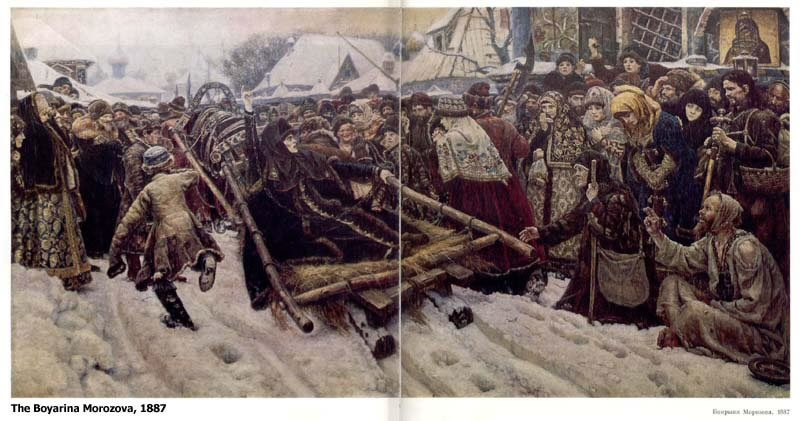
The picture above is a copy of my latest insanity. About a year ago, I thought it would be nice to do a cross-stitch of Something Russian to give to the Russian Dept. at the University, and I contacted a woman who specialized in converting Russian art to ask about this picture (Boyarina Morozova, by Surikov). Next thing I knew, she had converted the entire picture, and the cost was only $20 -- how could I say no? It uses, I think, 93 colors -- but consists of *73* pages of graph (my Train picture "only" has 15). I'm figuring on maybe the rest of my life to finish this one....
But the Russian Dept. has to share space with a lot of Classics snobs, and I figure, this image ought to give those Classics people something to think about. Or at least subdue them.
Wednesday, January 04, 2006
It Hasn't All Been About Russian
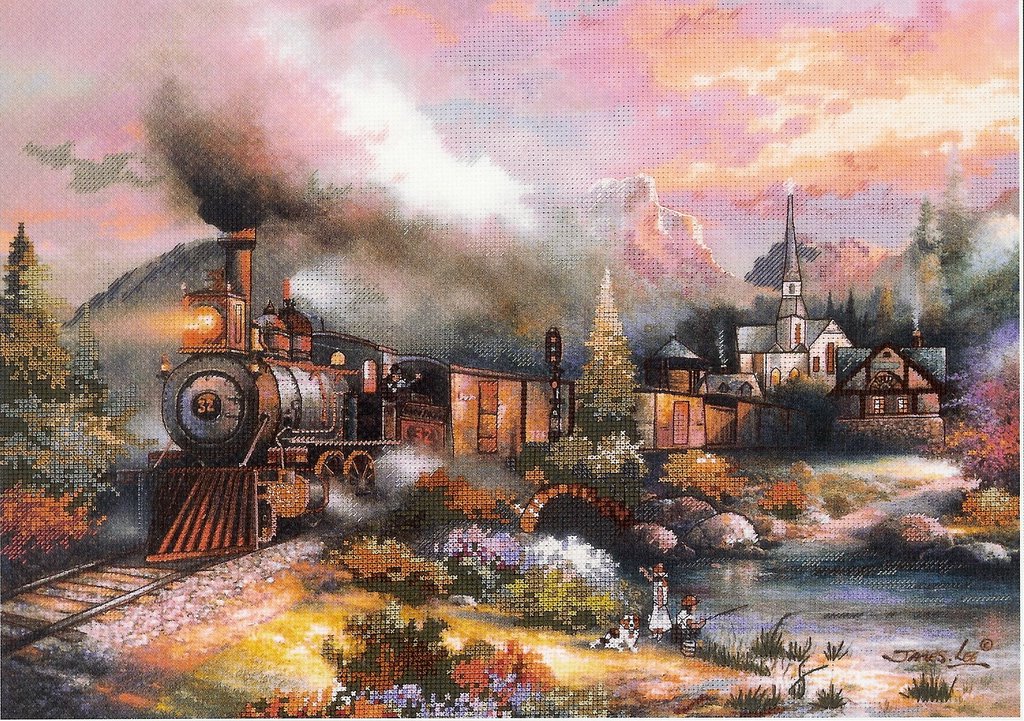
Back in September, after I finished a gift embroidery for my sister, I spotted this in a cross-stitch catalogue. You can imagine who came to mind, and I thought, "What a nifty Christmas present this would make!" and ordered it. When it came, I was massively disappointed: The thing is an "embellished cross stitch," which means it was screen-printed on 14-count Aida cloth, and you only stitch certain parts of it, leaving a stitchery with a whole lot of holes to be filled in.
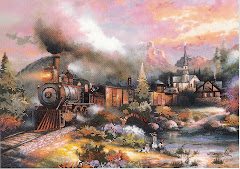
I checked with my cross-stitch group, who agreed with me: If I went with the original design, it would bother me every time I looked at it. So I scanned the photo into my computer and ran it through a program I have that creates cross stitch out of any picture you care to reproduce, and since October I've been working on this picture called, "Maryland Mountain Express."
Needless to say, it wasn't done in time for Christmas. It may not even be done in time for Chris's birthday, in June. But I am much happier with the results.
Slowing me down has been, not just the trip to Pennsylvania (this was way too big to tote along on a train!), but another project I foolishly got involved in: The World Trade Center Quilt. Some woman in Kentucky conceived the idea of piecing together a quilt made up of black Aida-cloth rectangles, each cross-stitched with 18 names of people who died at the World Trade Center on 9/11. Sounds like a great idea, right? One problem: Working with that black cloth. I really have to pace myself so I don't get eye strain. It will be some time before I ever work with black cloth again, I can tell you!
And there is one last project I promised to start this year. The woman who sold me the pattern has since had second thoughts about it, since she isn't sure how it will work up as a cross stitch, and I told her I would "model-stitch" it for her, which means I'm committed to getting something done with it. I just tried uploading it, and it's not coming up, so you'll have to look it up: Google images, then enter "Boyarina Morozova."
Some people would just say I should be committed, period. And I'm beginning to agree.
Tuesday, January 03, 2006
Sleeping What?!?!
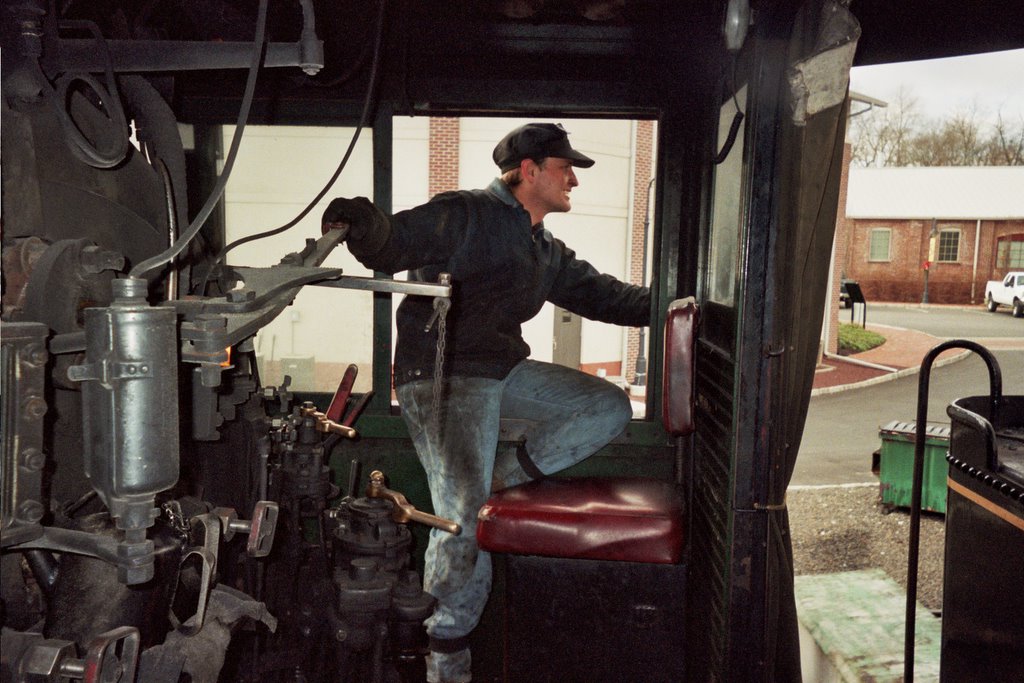
How about this handsome young fellow? See below....
I'd say something about Sleeping Beauty awakening, but since I will turn 60 this year, I think we can forget the "Beauty" part. More like Rip van Winkle.
In the crush of finishing up yet another semester of Russian (still asking myself why I'm doing this), I slipped several anniversaries of people's passing, including my own mother's -- probably just as well, considering how conflicted I still feel about her. In fact, today is an anniversary, but not of someone I knew well -- a high-school friend of my cousin's whom I had a crush on, till he undertook to let me know in no uncertain terms that he was "gay." Today marks the 12th anniversary of his passing, which means he was far too young to die -- I don't believe he reached his 50th birthday. Memory eternal, Kevin.
With Russian finally out of my hair for another month, I had all the usual Christmas prep to get into, except that this year, it included a trip to Pennsylvania -- yep, we visited our son! And what a lovely time we had! I must admit, it rather reminded me of one of those MasterCard ads: "Train tickets for two on the Acela Express: $xxx. Six nights at Comfort Inn: $xxx. Cost of rented car: $xxx. Look on son's face when we met at Union Station: priceless." We got lots of good pix of him running the locomotive, too. The one up top is just one. I must say, he works darned hard for his $10/hour.
On Sunday, we got to attend church at his new parish -- after attending one parish in the Philly area for 18 months, with only one or two people ever talking to him, and neither of them was the priest, he finally decided to pack it in there, and began attending a Greek parish in Elkins Park, which is only about another five miles for him to drive. What a lovely church! I wanted to see if I could get a postcard with pictures, but didn't have a chance to Explore. But he has already made a couple of friends there -- in fact, one lady said she and her husband had planned to invite him to dinner for Christmas Day -- and at least they have a Young Adult League, if he can ever find the time to get into it. My only concern is that it looks like there's a lot of money in that parish, and obviously, Chris isn't wealthy, or likely to be. However, in fairness, I must say that I've never found Greeks to be the type to turn up their noses at hard work. Anyway, it was a beautiful place, the choir loft was to die for -- up front, off to the side, graduated stands for the different parts, an organ behind all, and everyone facing towards the altar and the choir director -- and the singing was heavenly, although we didn't hear the choir -- they had sung at the Vesperal Liturgy the night before. Instead, there were three cantors, all with exquisite voices. I can't help hoping that Chris finds a real parish home here.
Needless to say, this trip was my only Christmas present, and my only birthday present. But it was all I wanted, anyway, and what better present could a mom get than a week without having to cook, clean, or wash clothes?
We have been back for almost a week, settling into the groove of getting back into those tasks, and me coping with a back that twisted into a pretzel the morning after we got home -- dratted bus ride from Boston to NH -- and dh fighting with a cold he picked up in a bar on our last night (the restaurant was packed, so we sat at the bar so the Working Stiffs could have a beer, at least. That was a mistake -- ciggie smoke everywhere, and that's how dh came down with his cold).
And I thought, well, it's about time I posted something. At least I had something to write about, for a change.
Tuesday, November 08, 2005
TAGGED!
I have been tagged by PhilippaAlan to name the top ten people who have influenced me, but they can't include God and family members. Since I once told an investigator that "Polaks don't have friends, they have relatives" (my stepfather is Polish, and I actually grew up thinking that the word "Polak" was a compliment), this promises to be a tough one. But we'll have to try.
1. Fr. Dean Panagos. In addition to being the kind of person who actually can do six impossible things before breakfast (one reason he doesn't drink coffee is that even without it, he's a bundle of nervous energy), he's the man who actually made me a choir director, and gave me my first real taste of spiritual direction. Sort of a modern-day St. John Chrysostom, not that he had a "golden tongue," but he's one of those people who just can't stand to see anyone hurting - and it galls him when someone can help, but doesn't. A real example of Christian living.
2. An anonymous cantor at the Lutheran Church in Kingston, NY. We were on vacation in upstate NY eons ago, when I was still Lutheran, and visited this church one Sunday. Because it was summer, there was no choir, but a female cantor sang all the responses with a voice as pure as a mountain stream. I listened to her, captivated, and thought, "Oh, if only I could sing like that!" - then went home and worked at it until I had something that sounded, to my ears, like what I had heard that Sunday. People always tell me I have a beautiful voice, and I can come up with half a dozen excuses as to why it sounds better than it is; but this lady is the real reason it sounds better than it is.
3. Aunt Clara. No, she doesn't count as a relative, because she was an "aunt" in the same sense that Uncle Tony was an "uncle" -- a close friend of the family. She was middle-aged, with two grown sons, and very lonely, when she started a club for the neighborhood girls, where she taught us to embroider and crochet. These days I still embroider and crochet, as well as knitting, and every time I pick up a needle I think of her.
4. Aunt Catherine. Same kind of "aunt." She was Aunt Clara's tenant, and if Aunt Clara taught me skills that stayed with me a lifetime, Aunt Catherine, with her bovine placidity, provided me with the kind of mothering I so desperately needed: milk and cookies, and someone to talk to about nothing much. I don't know it for a fact, but I suspect that my childhood would have been far worse than it was, if these two ladies hadn't ridden herd on my mother from time to time.
5. Helga Schultz, my best friend in Germany. I wouldn't be able to speak German if she hadn't made friends with me. I drank more coffee at her house, and learned all the figures of speech you don't learn in class, including a little ditty about all the "apes in Aschaffenburg" (it rhymes better in German).
6. Peter Bochow, the man who taught German at the University of Maryland Rhein/Main campus. One day I went to the German consulate in Boston to inquire about German legal procedures, and got talking with an attache who said, after about an hour, "So, you too are living here. Where are you from?" You should have seen his eyes when I said, "New York" -- he thought I was a native German! That's due to the man I knew as Herr Bochow. I still speak it fluently, more than 30 years later.
7. Elizabeth Zimmermann, the knitting guru, author of Knitting Without Tears and a number of other books on the craft of knitting. Up until reading her books I was, like so many other women, enslaved to printed patterns. "EZ" freed us from all that, from knitting in back-and-forth rows, from having to sew up seams, and best of all, from knitting with acrylics, whose charm fades the first time you wash a hand-knitted garment in the machine and see what a felted mess it comes out. I owe my identity as a sheep (long story), and my predilection for wool, to EZ.
8. Fr. Andrei Papkov and his wife, Natasha. Fr. Andrei is the director of the Summer School for Liturgical Music in Jordanville, NY, and his wife is the cook/secretary/surrogate Mom of the place. That I kept coming back for four summers of gruelling study says more about the dedication, patience, and sense of humor of these two people, than about anything musical I might have going for me.
9. John Livio, accordion teacher. It's only as I've grown older that I've come to appreciate what a wretched way to earn a living it is to travel to people's homes and teach their little monsters a musical instrument. In our neighborhood, accordions were a popular instrument, and in my family, about as close as I would ever get to a piano, until I was grown. That I can read music at all is due entirely to Mr. Livio.
OK, OK, scraping the bottom of the barrel here.... I know I can find just one more.... Wait, wait....
10. Sr. Rose Gabriel, who taught floundering high-school graduates the basics of business practice. All of us who attended her school, the Kaupert Secretarial Institute, were graduates of various high schools with an exclusively academic track, but for one reason or another we hadn't gone on to college, and were completely unemployable without it. Sr. Rose Gabriel taught us typing, shorthand, and business English; how to write a business letter; how to file, and generally how to run an office like a well-oiled machine. And to my astonishment, I discovered something I was good at. I think it was the first time in my life I ever felt good at anything, which, considering I had a Regents' diploma in languages from the New York State Board of Regents, should tell you something about my self-image -- they don't hand out Regents' diplomas on the strength of how well you bat your eyelashes (if they did, I still wouldn't have gotten one).
A good exercise in contemplating gratitude, in this month of Thanksgiving. Now, whom can I tag?.... Well, considering I don't know who else reads this blog, that leaves Mimi and Catherine! Sorry, girls, you're It!
1. Fr. Dean Panagos. In addition to being the kind of person who actually can do six impossible things before breakfast (one reason he doesn't drink coffee is that even without it, he's a bundle of nervous energy), he's the man who actually made me a choir director, and gave me my first real taste of spiritual direction. Sort of a modern-day St. John Chrysostom, not that he had a "golden tongue," but he's one of those people who just can't stand to see anyone hurting - and it galls him when someone can help, but doesn't. A real example of Christian living.
2. An anonymous cantor at the Lutheran Church in Kingston, NY. We were on vacation in upstate NY eons ago, when I was still Lutheran, and visited this church one Sunday. Because it was summer, there was no choir, but a female cantor sang all the responses with a voice as pure as a mountain stream. I listened to her, captivated, and thought, "Oh, if only I could sing like that!" - then went home and worked at it until I had something that sounded, to my ears, like what I had heard that Sunday. People always tell me I have a beautiful voice, and I can come up with half a dozen excuses as to why it sounds better than it is; but this lady is the real reason it sounds better than it is.
3. Aunt Clara. No, she doesn't count as a relative, because she was an "aunt" in the same sense that Uncle Tony was an "uncle" -- a close friend of the family. She was middle-aged, with two grown sons, and very lonely, when she started a club for the neighborhood girls, where she taught us to embroider and crochet. These days I still embroider and crochet, as well as knitting, and every time I pick up a needle I think of her.
4. Aunt Catherine. Same kind of "aunt." She was Aunt Clara's tenant, and if Aunt Clara taught me skills that stayed with me a lifetime, Aunt Catherine, with her bovine placidity, provided me with the kind of mothering I so desperately needed: milk and cookies, and someone to talk to about nothing much. I don't know it for a fact, but I suspect that my childhood would have been far worse than it was, if these two ladies hadn't ridden herd on my mother from time to time.
5. Helga Schultz, my best friend in Germany. I wouldn't be able to speak German if she hadn't made friends with me. I drank more coffee at her house, and learned all the figures of speech you don't learn in class, including a little ditty about all the "apes in Aschaffenburg" (it rhymes better in German).
6. Peter Bochow, the man who taught German at the University of Maryland Rhein/Main campus. One day I went to the German consulate in Boston to inquire about German legal procedures, and got talking with an attache who said, after about an hour, "So, you too are living here. Where are you from?" You should have seen his eyes when I said, "New York" -- he thought I was a native German! That's due to the man I knew as Herr Bochow. I still speak it fluently, more than 30 years later.
7. Elizabeth Zimmermann, the knitting guru, author of Knitting Without Tears and a number of other books on the craft of knitting. Up until reading her books I was, like so many other women, enslaved to printed patterns. "EZ" freed us from all that, from knitting in back-and-forth rows, from having to sew up seams, and best of all, from knitting with acrylics, whose charm fades the first time you wash a hand-knitted garment in the machine and see what a felted mess it comes out. I owe my identity as a sheep (long story), and my predilection for wool, to EZ.
8. Fr. Andrei Papkov and his wife, Natasha. Fr. Andrei is the director of the Summer School for Liturgical Music in Jordanville, NY, and his wife is the cook/secretary/surrogate Mom of the place. That I kept coming back for four summers of gruelling study says more about the dedication, patience, and sense of humor of these two people, than about anything musical I might have going for me.
9. John Livio, accordion teacher. It's only as I've grown older that I've come to appreciate what a wretched way to earn a living it is to travel to people's homes and teach their little monsters a musical instrument. In our neighborhood, accordions were a popular instrument, and in my family, about as close as I would ever get to a piano, until I was grown. That I can read music at all is due entirely to Mr. Livio.
OK, OK, scraping the bottom of the barrel here.... I know I can find just one more.... Wait, wait....
10. Sr. Rose Gabriel, who taught floundering high-school graduates the basics of business practice. All of us who attended her school, the Kaupert Secretarial Institute, were graduates of various high schools with an exclusively academic track, but for one reason or another we hadn't gone on to college, and were completely unemployable without it. Sr. Rose Gabriel taught us typing, shorthand, and business English; how to write a business letter; how to file, and generally how to run an office like a well-oiled machine. And to my astonishment, I discovered something I was good at. I think it was the first time in my life I ever felt good at anything, which, considering I had a Regents' diploma in languages from the New York State Board of Regents, should tell you something about my self-image -- they don't hand out Regents' diplomas on the strength of how well you bat your eyelashes (if they did, I still wouldn't have gotten one).
A good exercise in contemplating gratitude, in this month of Thanksgiving. Now, whom can I tag?.... Well, considering I don't know who else reads this blog, that leaves Mimi and Catherine! Sorry, girls, you're It!
Saturday, November 05, 2005
I Can See Clearly with the Windows Washed
I can see clearly now the rain is gone.
I can see all obstacles in my way.
Gone are the dark clouds that can't go on [I think]:
'S gonna be a bright, bright, sunshiney day.
Today I finished washing my porch windows. There are ten of them, and frankly, if it had been up to me, I would never have enclosed the porch in the first place; but it was already enclosed when we bought the place, and the windows were heavy aluminum things that took me two days to wash, and I would always cut my fingers on them. So, shortly after we moved in, we had them replaced with vinyl windows that tilt in for cleaning, which is a very nice feature indeed.
Except that those suckers are heavy. I hadn't realized, when we signed the contract, just how heavy they are, and they haven't gotten any lighter as I've grown older. So it still takes me two days to wash all ten windows, but at least that's 2-3 hours of work in the morning, not the entire day, as it used to be with those dratted aluminum things.
Now...the other thing about this particular entry is that it has been (ahem) three years since I last washed those windows. To be fair, the porch faces west, which means that in the Summer, it's beastly hot out there, and I shut down for the Summer anyway; my Summer existence, best described as "aestating" (since how can you hibernate in the Summer?), consists of sitting in any available chair, drinking large quantities of water and moaning, "I wish it would cool off." Laundry is about all I'm capable of, in the Summer. (It's wet, and therefore cool.) So to wash windows on a west-facing porch at that time of year counts as Cruel and Unusual Punishment for me.
So the only times of the year those windows can possibly be washed are Spring and Autumn. And for the past three years, both Spring and Autumn have been unremittingly wet, the only odd sunny day falling, naturally, on a Sunday, which is not supposed to be spent washing windows. In theory, that's what the rest of the week is for, something I have reminded the Almighty of every Spring and Fall for the past three years.
This year, He rewarded my patience with the usual unconscionably wet Autumn; but this year, He has gifted us with an unusually warm November. I never look askance at gifts from the Almighty. So yesterday, I was out there with rags and Windex; a brush for cleaning off the screens and windowsills, and a bottle of all-purpose cleanser; a can of silicone spray because after three years, it was a given that those windows would stick (and they did); and a watering can, a small one with a long spout. First I brushed down the screens, and then I took them out; then I tilted in the window and washed it, sprayed the sides with the silicone, then washed the insides; then I raised the bottom window, sprayed the sills with the cleanser, and wiped them down; and lastly, I poured hot water from the watering can into the little pockets on the sides of the window that supposedly make it airtight, and that are THE most colossal pain to clean. That watering can was sheer genius, let me tell you.
While I was doing this, I had the curtains washing, and when they were done, I hung them back up -- still damp -- and let them air-dry on the porch. The smell is incredibly sweet, and the house gets humidified that way.
I did that ten times, once for each window, and I'm telling you, that was a full-body workout. The next time my doctor dares mention "heart attack" to me, I'm going to make her a proposition: "Listen, Toots, tell you what. You write this down and put in a Safe Place, and take it out when you're one year shy of sixty. And if you can climb up and down a step ladder fifty times, wash ten heavy windows, batten down the locks that seal them shut for the winter, and hang up wet curtains -- then you can bellyache to your patients about heart disease. But I don't wanna hear it."
I can see all obstacles in my way.
Gone are the dark clouds that can't go on [I think]:
'S gonna be a bright, bright, sunshiney day.
Today I finished washing my porch windows. There are ten of them, and frankly, if it had been up to me, I would never have enclosed the porch in the first place; but it was already enclosed when we bought the place, and the windows were heavy aluminum things that took me two days to wash, and I would always cut my fingers on them. So, shortly after we moved in, we had them replaced with vinyl windows that tilt in for cleaning, which is a very nice feature indeed.
Except that those suckers are heavy. I hadn't realized, when we signed the contract, just how heavy they are, and they haven't gotten any lighter as I've grown older. So it still takes me two days to wash all ten windows, but at least that's 2-3 hours of work in the morning, not the entire day, as it used to be with those dratted aluminum things.
Now...the other thing about this particular entry is that it has been (ahem) three years since I last washed those windows. To be fair, the porch faces west, which means that in the Summer, it's beastly hot out there, and I shut down for the Summer anyway; my Summer existence, best described as "aestating" (since how can you hibernate in the Summer?), consists of sitting in any available chair, drinking large quantities of water and moaning, "I wish it would cool off." Laundry is about all I'm capable of, in the Summer. (It's wet, and therefore cool.) So to wash windows on a west-facing porch at that time of year counts as Cruel and Unusual Punishment for me.
So the only times of the year those windows can possibly be washed are Spring and Autumn. And for the past three years, both Spring and Autumn have been unremittingly wet, the only odd sunny day falling, naturally, on a Sunday, which is not supposed to be spent washing windows. In theory, that's what the rest of the week is for, something I have reminded the Almighty of every Spring and Fall for the past three years.
This year, He rewarded my patience with the usual unconscionably wet Autumn; but this year, He has gifted us with an unusually warm November. I never look askance at gifts from the Almighty. So yesterday, I was out there with rags and Windex; a brush for cleaning off the screens and windowsills, and a bottle of all-purpose cleanser; a can of silicone spray because after three years, it was a given that those windows would stick (and they did); and a watering can, a small one with a long spout. First I brushed down the screens, and then I took them out; then I tilted in the window and washed it, sprayed the sides with the silicone, then washed the insides; then I raised the bottom window, sprayed the sills with the cleanser, and wiped them down; and lastly, I poured hot water from the watering can into the little pockets on the sides of the window that supposedly make it airtight, and that are THE most colossal pain to clean. That watering can was sheer genius, let me tell you.
While I was doing this, I had the curtains washing, and when they were done, I hung them back up -- still damp -- and let them air-dry on the porch. The smell is incredibly sweet, and the house gets humidified that way.
I did that ten times, once for each window, and I'm telling you, that was a full-body workout. The next time my doctor dares mention "heart attack" to me, I'm going to make her a proposition: "Listen, Toots, tell you what. You write this down and put in a Safe Place, and take it out when you're one year shy of sixty. And if you can climb up and down a step ladder fifty times, wash ten heavy windows, batten down the locks that seal them shut for the winter, and hang up wet curtains -- then you can bellyache to your patients about heart disease. But I don't wanna hear it."
Sunday, October 30, 2005
Uncle Tony: 1922? - 1997
Uncle Tony. I never think of the man, or speak about him, without a smile coming to my lips. Uncle Tony was a "Dutch uncle," not really a blood relative but such a close friend of the family that you referred to him as your uncle, and we had a lot of those when I was growing up. He went to school with my Uncle Buddy, so I'm pretty sure he was born in 1922 or 1923, and although he never married, I think he was half in love with my mother -- he certainly spent enough time at our house. Heaven alone knows why he didn't ask my mother to marry him, when she was available.
Every Saturday night he'd come for a visit, along with his friend, Bill Roach, who was from Ireland; and he and my parents would talk about everything under the sun, politics, religion, baseball -- football wasn't nearly as popular as baseball back then -- oddly enough, I don't recall anyone ever talking about the job. I'm not even sure what Uncle Tony did for a living, though I think it was something to do with the Parks Dept. of NYC. But what a character he was! I almost never saw him serious, I don't believe I ever saw him angry, unless his anger took the form of biting humor; and the most serious thing he ever said to me was, "Whatever you do, don't grow up like your Aunt Mary." Since I idolized Aunt Mary, I was shocked he would say such a thing; now, I understand all too well what he meant. (More about her on the anniversary of her death.)
When I began working, for reasons I will never understand, he began "dating" me. I never thought of our excursions as dates -- after all, he was 25 years my senior -- but I don't know what else to call them. Namely, he would take me to dinner and a Broadway show. I saw more Broadway shows than any young woman has a right to claim she saw: Cabaret, Auntie Mame, Butterflies Are Free, Barefoot in the Park -- gosh, I've forgotten more than I can remember. We went out about once every two months. He was always very careful of my safety, and I appreciated that, though probably not as much as I should have.... Thinking back, I have to say he was one of the best people I have ever known, one of the most ethical, one of the most moral. I can only think of maybe five other people I could say that about.
Unless you got him on the subject of politics, or the Catholic Church. Like most of us in our part of town, Uncle Tony had grown up a staunch Catholic, never missed Mass, and as his parents aged -- he lived all his life with them, till they died -- he'd take them to daily Mass before going to work. Vatican II was a catastrophe for him. There was nothing he liked about any of the changes, and he was very voluble on each one of them (and there were a lot of them). His friend Bill Roach finally joined a radical sect of Irish monks whose order stood in complete defiance of any kind of changes. I'm a little surprised Uncle Tony didn't go along with him.
And politics. We were all Democrats in our part of town, since "the Democratic Party was the Party of the working man," and as a secretary, I was about as white-collar as it got in our part of town. But what most of us distrusted about John V. Lindsay was not that he was a Republican, but that he had such liberal ideas -- expansion of welfare took place in his administration, police power was radically curtailed, and it seemed to all of us that the City began to deteriorate while he was mayor. And no one was more voluble on the subject of that deterioration than Uncle Tony. To be fair, he and all his generation could remember a time when you could ride the subway system at 3:00 in the morning and never fear being molested, and gradually it got so you couldn't set foot outside your door without risking your life or at least your wallet.
Anyway, Uncle Tony was one of the first to break with the Democratic mold, when he supported Bill Buckley for mayor, who ran on the Conservative ticket. Between that and Vatican II, it suddenly seemed as if anything was possible! He became very well read, and despite never having gone above high school -- in our neighborhood, completing high school was an achievement -- he could discuss any and all of the great philosophers and theologians, dissect the downfall of New York with a knowledge that could at least have matched Buckley's, and demolish the arguments of pundits with a wealth of a lifetime's experience.
As he grew older, though, he became a bit strange. He took to holing up in his apartment, especially after his father died, and reading more and more extreme right-wing publications. At one point, well after I was married, it suddenly occurred to me that I hadn't seen him in quite some time, so I asked my mother how he was doing -- and she didn't know. After his retirement, he simply became a recluse. Very occasionally he'd call my mother, but the only person he really saw from day to day was his cousin Joe.
And it was his cousin Joe who, having called for a few days without Uncle Tony's picking up the phone, found him dead in his apartment. It's a sad thing to say about anybody that it isn't known exactly when he died, but worse nowadays, when we know so much about everything, and everyone. Yet, that's what happened to Uncle Tony; all we can say is that he passed on sometime between October 28 and October 31. It seems such a sad end for someone who was so large a part of my life, and my brothers' and sister's, as well. I wonder what he would have made of my becoming Orthodox; I think this faith would have suited him very well, if he had been able to break out of his firm belief in the rightness of the rule of the Pope. I don't know if he could ever have managed that; but I think of him at this time every year, and today I'll be able to light a candle for him. It's the least I can do; my life would be so much poorer without his influence.
Every Saturday night he'd come for a visit, along with his friend, Bill Roach, who was from Ireland; and he and my parents would talk about everything under the sun, politics, religion, baseball -- football wasn't nearly as popular as baseball back then -- oddly enough, I don't recall anyone ever talking about the job. I'm not even sure what Uncle Tony did for a living, though I think it was something to do with the Parks Dept. of NYC. But what a character he was! I almost never saw him serious, I don't believe I ever saw him angry, unless his anger took the form of biting humor; and the most serious thing he ever said to me was, "Whatever you do, don't grow up like your Aunt Mary." Since I idolized Aunt Mary, I was shocked he would say such a thing; now, I understand all too well what he meant. (More about her on the anniversary of her death.)
When I began working, for reasons I will never understand, he began "dating" me. I never thought of our excursions as dates -- after all, he was 25 years my senior -- but I don't know what else to call them. Namely, he would take me to dinner and a Broadway show. I saw more Broadway shows than any young woman has a right to claim she saw: Cabaret, Auntie Mame, Butterflies Are Free, Barefoot in the Park -- gosh, I've forgotten more than I can remember. We went out about once every two months. He was always very careful of my safety, and I appreciated that, though probably not as much as I should have.... Thinking back, I have to say he was one of the best people I have ever known, one of the most ethical, one of the most moral. I can only think of maybe five other people I could say that about.
Unless you got him on the subject of politics, or the Catholic Church. Like most of us in our part of town, Uncle Tony had grown up a staunch Catholic, never missed Mass, and as his parents aged -- he lived all his life with them, till they died -- he'd take them to daily Mass before going to work. Vatican II was a catastrophe for him. There was nothing he liked about any of the changes, and he was very voluble on each one of them (and there were a lot of them). His friend Bill Roach finally joined a radical sect of Irish monks whose order stood in complete defiance of any kind of changes. I'm a little surprised Uncle Tony didn't go along with him.
And politics. We were all Democrats in our part of town, since "the Democratic Party was the Party of the working man," and as a secretary, I was about as white-collar as it got in our part of town. But what most of us distrusted about John V. Lindsay was not that he was a Republican, but that he had such liberal ideas -- expansion of welfare took place in his administration, police power was radically curtailed, and it seemed to all of us that the City began to deteriorate while he was mayor. And no one was more voluble on the subject of that deterioration than Uncle Tony. To be fair, he and all his generation could remember a time when you could ride the subway system at 3:00 in the morning and never fear being molested, and gradually it got so you couldn't set foot outside your door without risking your life or at least your wallet.
Anyway, Uncle Tony was one of the first to break with the Democratic mold, when he supported Bill Buckley for mayor, who ran on the Conservative ticket. Between that and Vatican II, it suddenly seemed as if anything was possible! He became very well read, and despite never having gone above high school -- in our neighborhood, completing high school was an achievement -- he could discuss any and all of the great philosophers and theologians, dissect the downfall of New York with a knowledge that could at least have matched Buckley's, and demolish the arguments of pundits with a wealth of a lifetime's experience.
As he grew older, though, he became a bit strange. He took to holing up in his apartment, especially after his father died, and reading more and more extreme right-wing publications. At one point, well after I was married, it suddenly occurred to me that I hadn't seen him in quite some time, so I asked my mother how he was doing -- and she didn't know. After his retirement, he simply became a recluse. Very occasionally he'd call my mother, but the only person he really saw from day to day was his cousin Joe.
And it was his cousin Joe who, having called for a few days without Uncle Tony's picking up the phone, found him dead in his apartment. It's a sad thing to say about anybody that it isn't known exactly when he died, but worse nowadays, when we know so much about everything, and everyone. Yet, that's what happened to Uncle Tony; all we can say is that he passed on sometime between October 28 and October 31. It seems such a sad end for someone who was so large a part of my life, and my brothers' and sister's, as well. I wonder what he would have made of my becoming Orthodox; I think this faith would have suited him very well, if he had been able to break out of his firm belief in the rightness of the rule of the Pope. I don't know if he could ever have managed that; but I think of him at this time every year, and today I'll be able to light a candle for him. It's the least I can do; my life would be so much poorer without his influence.
Wednesday, October 19, 2005
Tag! You're It!
PhilippaAlan tagged me (I know I should enter her bloglink, but I have no idea how to do that)! I've never been tagged before:
Five things I plan or hope to do before I die:
1. Speak Russian at least passably
2. Finish all my cross-stitch projects
3. Get through my stash of knitting wool
4. Learn the basics of painting and sketching, so I can design my own cross stitch
5. Figure out what I want to be when I grow up ;-)
Five things I can do:
1. Speak, read and write German fluently
2. Accounting/Bookkeeping
3. Cross stitch and knit
4. Secretarial stuff (which I love)
5. Chant the Church offices
Five things I cannot do:
1. Rollerblade, ski
2. Speak Spanish, nor do I want to
3. Find my way around Boston
4. Travel on high mountain roads
5. Really clean a house
Five things that attract me to the opposite sex:
1. Intelligence
2. Piety
3. Patience
4. Humor
5. Compassion
Five things I say most often:
1. Lord Jesus Christ, Son of God, have mercy on me, a sinner
2. Oh for cryin' out loud....
3. If I had a nickel for every time I saw/did/thought [whatever], I'd be rich by now.
4. See that lady running down the street? That's me, racing to [buy new product/do latest thing -- neither of which I would dream of doing in this lifetime].
5. I wish [one kid or the other] would call.
Five Celebrity Crushes:
1. Sean Connery
2. Mel Gibson
3. Pierce Brosnan
4. George & Laura Bush (together -- I think they're so cute)
5. Hey, I'm lucky I could scrounge up four!!
Tag! You’re it!
Mimi
Elizabeth
Christa
Five things I plan or hope to do before I die:
1. Speak Russian at least passably
2. Finish all my cross-stitch projects
3. Get through my stash of knitting wool
4. Learn the basics of painting and sketching, so I can design my own cross stitch
5. Figure out what I want to be when I grow up ;-)
Five things I can do:
1. Speak, read and write German fluently
2. Accounting/Bookkeeping
3. Cross stitch and knit
4. Secretarial stuff (which I love)
5. Chant the Church offices
Five things I cannot do:
1. Rollerblade, ski
2. Speak Spanish, nor do I want to
3. Find my way around Boston
4. Travel on high mountain roads
5. Really clean a house
Five things that attract me to the opposite sex:
1. Intelligence
2. Piety
3. Patience
4. Humor
5. Compassion
Five things I say most often:
1. Lord Jesus Christ, Son of God, have mercy on me, a sinner
2. Oh for cryin' out loud....
3. If I had a nickel for every time I saw/did/thought [whatever], I'd be rich by now.
4. See that lady running down the street? That's me, racing to [buy new product/do latest thing -- neither of which I would dream of doing in this lifetime].
5. I wish [one kid or the other] would call.
Five Celebrity Crushes:
1. Sean Connery
2. Mel Gibson
3. Pierce Brosnan
4. George & Laura Bush (together -- I think they're so cute)
5. Hey, I'm lucky I could scrounge up four!!
Tag! You’re it!
Mimi
Elizabeth
Christa
Monday, October 17, 2005
The Things We Do for Love...
"Like walkin' in the rain and the snow, when there's nowhere to go,
And it's feelin' like a part of you is dyin',
And you're searchin' for the answer in her eyes.
You think you're gonna break up, then she says she wants to make up...
The things we do for love!"
I like to listen to Oldies in the car, "great music from the 60s and 70s," is how this particular station bills itself. I was pretty much out of rock 'n' roll by the 70s, so a lot of this stuff is new to me; but I like the way it addresses modern life, even if I don't agree with much of what it says.
For the past weekend, I've had this particular song rattling around in my head. It reminds me of so many things: "Walking in the rain and the snow" reminds me of how my son must have felt when his girlfriend broke up with him, with very little warning, it seems. I think he's recovering now, but at the time, I think he felt sandbagged. And then, of course, there's this past weekend, when the whole family is "walking in the rain and the snow when there's nowhere to go," muddling around in an emotional fog, trying to come to grips with something that should never have happened -- but it seems it happens to quite a few folks. I'm talking, of course, about the miscarriage. Knowing that there's a whole army of women out there who cherish the memory of someone they knew for all too short a time, doesn't help at all.
But "the things we do for love...." The hardest part of these past several months, going back to when Ruth and Chris broke up, has been not saying anything about it. Well, yeah, I did vent a bit here, thinking, in my naivete, that it was a "safe place," since neither of them (as far as I knew) knew about this blog -- still don't know how they found out about it, but I take no responsibility for the flap that ensued. They weren't *supposed* to know about it, and as far as I'm concerned, I did my best to keep my feelings from them.
But I'm finding that this isn't going away, any more than the loss of my prospective grandchild will go away. I find myself working at my embroidery and thinking about Ruth, and how much I looked forward to sharing this skill with her, since she professed herself interested in embroidery and knitting. I was really looking forward to sharing a lot of things with her, and now, that's out of the picture. But I still find myself thinking about it, and gradually I'm coming to realize: I lost something, too, when that relationship went south. I really liked this girl; there was a lot to like.
And now, with the loss of the baby, I'm being asked to put a lid on myself again, not to share in my daughter's grief, just because I've never had a miscarriage. That's not the point. The point is, this is my child who is suffering, and I wish she'd let me close enough just to cry with her. Then again, this being my daughter, she's not someone who shares grief easily; when she broke up with her last serious boyfriend before her husband, it was six months before I found out that he had dumped her. She has someone to share her grief with, the most appropriate person of all: her husband.
But I'd at least like to note that she isn't the only one grieving over the loss of her baby. Chris isn't the only one grieving over the loss of Ruth. Oh, drat the things we do for love!
And it's feelin' like a part of you is dyin',
And you're searchin' for the answer in her eyes.
You think you're gonna break up, then she says she wants to make up...
The things we do for love!"
I like to listen to Oldies in the car, "great music from the 60s and 70s," is how this particular station bills itself. I was pretty much out of rock 'n' roll by the 70s, so a lot of this stuff is new to me; but I like the way it addresses modern life, even if I don't agree with much of what it says.
For the past weekend, I've had this particular song rattling around in my head. It reminds me of so many things: "Walking in the rain and the snow" reminds me of how my son must have felt when his girlfriend broke up with him, with very little warning, it seems. I think he's recovering now, but at the time, I think he felt sandbagged. And then, of course, there's this past weekend, when the whole family is "walking in the rain and the snow when there's nowhere to go," muddling around in an emotional fog, trying to come to grips with something that should never have happened -- but it seems it happens to quite a few folks. I'm talking, of course, about the miscarriage. Knowing that there's a whole army of women out there who cherish the memory of someone they knew for all too short a time, doesn't help at all.
But "the things we do for love...." The hardest part of these past several months, going back to when Ruth and Chris broke up, has been not saying anything about it. Well, yeah, I did vent a bit here, thinking, in my naivete, that it was a "safe place," since neither of them (as far as I knew) knew about this blog -- still don't know how they found out about it, but I take no responsibility for the flap that ensued. They weren't *supposed* to know about it, and as far as I'm concerned, I did my best to keep my feelings from them.
But I'm finding that this isn't going away, any more than the loss of my prospective grandchild will go away. I find myself working at my embroidery and thinking about Ruth, and how much I looked forward to sharing this skill with her, since she professed herself interested in embroidery and knitting. I was really looking forward to sharing a lot of things with her, and now, that's out of the picture. But I still find myself thinking about it, and gradually I'm coming to realize: I lost something, too, when that relationship went south. I really liked this girl; there was a lot to like.
And now, with the loss of the baby, I'm being asked to put a lid on myself again, not to share in my daughter's grief, just because I've never had a miscarriage. That's not the point. The point is, this is my child who is suffering, and I wish she'd let me close enough just to cry with her. Then again, this being my daughter, she's not someone who shares grief easily; when she broke up with her last serious boyfriend before her husband, it was six months before I found out that he had dumped her. She has someone to share her grief with, the most appropriate person of all: her husband.
But I'd at least like to note that she isn't the only one grieving over the loss of her baby. Chris isn't the only one grieving over the loss of Ruth. Oh, drat the things we do for love!
Saturday, October 08, 2005
George: 1944-2000
This should actually have been posted yesterday, since he passed on October 7. But this has been a thoroughly stupid week, with all kinds of stupid, pointless running around, and yesterday was no exception.
George and my husband were in high school together, and somehow, improbably, became friends. George was from Brooklyn; Jim is from Queens. (Each borough regards the other as a foreign country.) George's background was Polish; Jim's is German and Irish. George majored in physics in college; Jim majored in English. George loved art; Jim loves music. George was a Francophile; Jim is a Germanophile. They used to razz each other mercilessly about George's predilection for Impressionist art (Jim called it "fuzzy"), and Jim's sartorial gaffes (I still remember George telling Jim that his orange socks were "so autumnal, they'll start falling down any second"). George was an anti-war hippie; Jim served in the Air Force.
Improbably, the two became friends in high school, and the friendship lasted -- with all its jagged edges and hard places -- until the incredible phone call came from George's wife that he had died. They were out shopping when he said, "I feel a little strange." Then asked her to take him to the hospital. Then died in the car seat next to her. Turned out he had had a massive heart attack. Yet, just four months previously, he had had a thorough physical and been pronounced in excellent health.
We had last seen him and his wife just a year previously, at our daughter's wedding. We hadn't really expected them to come, and were so pleased that they did; we hadn't seen them for five years previously, though we had kept in touch all that time. When they left to go back home, they promised us the next time wouldn't be so long, that they'd be up on a fall foliage tour the following year. On our daughter's first anniversary, we were attending George's wake.
When he died, he had just retired from New York University and was teaching at a small community college in Queens. At his wake, all his students came to pay their respects, and I heard so many comments about what a truly excellent and caring teacher he had been; and that was new to me too -- I had always known George only as a research scientist. On the way to the cemetery, his wife told us about the trip they had taken to Poland to see George's grandparents' village, and how George had taught himself Polish so he could communicate with his relatives. My stepfather is Polish, and let me tell you -- that is a tough language to learn. But George managed it.
Typical for a Francophile and a scientist of Polish background, his relationship with God was ambiguous: he was an "A&P" Catholic ("ashes and palms"), but his music collection ran to several settings of Masses and Liturgies, many of them Orthodox. He probably subscribed to the "Timekeeper" theory of God, the God Who set everything in motion and then sat back to watch it all spin itself out. I don't think he ever disbelieved in God; I've never met a successful Polish atheist. I sometimes wonder how he's making out now, but there's one conversation I would love to have heard:
George once said to Jim that the Italian baroque composer Antonio Vivaldi had written the same concerto 400 times (there are 400 works ascribed to Vivaldi, and they do all sound as if they were written to a fixed formula). I'd love to know what George said to Vivaldi when he actually met him. ;-)
George and my husband were in high school together, and somehow, improbably, became friends. George was from Brooklyn; Jim is from Queens. (Each borough regards the other as a foreign country.) George's background was Polish; Jim's is German and Irish. George majored in physics in college; Jim majored in English. George loved art; Jim loves music. George was a Francophile; Jim is a Germanophile. They used to razz each other mercilessly about George's predilection for Impressionist art (Jim called it "fuzzy"), and Jim's sartorial gaffes (I still remember George telling Jim that his orange socks were "so autumnal, they'll start falling down any second"). George was an anti-war hippie; Jim served in the Air Force.
Improbably, the two became friends in high school, and the friendship lasted -- with all its jagged edges and hard places -- until the incredible phone call came from George's wife that he had died. They were out shopping when he said, "I feel a little strange." Then asked her to take him to the hospital. Then died in the car seat next to her. Turned out he had had a massive heart attack. Yet, just four months previously, he had had a thorough physical and been pronounced in excellent health.
We had last seen him and his wife just a year previously, at our daughter's wedding. We hadn't really expected them to come, and were so pleased that they did; we hadn't seen them for five years previously, though we had kept in touch all that time. When they left to go back home, they promised us the next time wouldn't be so long, that they'd be up on a fall foliage tour the following year. On our daughter's first anniversary, we were attending George's wake.
When he died, he had just retired from New York University and was teaching at a small community college in Queens. At his wake, all his students came to pay their respects, and I heard so many comments about what a truly excellent and caring teacher he had been; and that was new to me too -- I had always known George only as a research scientist. On the way to the cemetery, his wife told us about the trip they had taken to Poland to see George's grandparents' village, and how George had taught himself Polish so he could communicate with his relatives. My stepfather is Polish, and let me tell you -- that is a tough language to learn. But George managed it.
Typical for a Francophile and a scientist of Polish background, his relationship with God was ambiguous: he was an "A&P" Catholic ("ashes and palms"), but his music collection ran to several settings of Masses and Liturgies, many of them Orthodox. He probably subscribed to the "Timekeeper" theory of God, the God Who set everything in motion and then sat back to watch it all spin itself out. I don't think he ever disbelieved in God; I've never met a successful Polish atheist. I sometimes wonder how he's making out now, but there's one conversation I would love to have heard:
George once said to Jim that the Italian baroque composer Antonio Vivaldi had written the same concerto 400 times (there are 400 works ascribed to Vivaldi, and they do all sound as if they were written to a fixed formula). I'd love to know what George said to Vivaldi when he actually met him. ;-)
Monday, October 03, 2005
Glory to God for all things!
Our daughter usually telephones us on Sunday nights. She's missed the last few weeks while her son goes through a "sleep adjustment," basically growing out of his afternoon nap, at the ripe old age of two. When I was a kid, it was a rare child who didn't need an afternoon nap even in kindergarten.
However, she had momentous news: Her home pregnancy test confirmed that she is expecting her second in June. For me, the strangest part of grandmotherhood is seeing my daughter -- the fruit of my own womb -- being fruitful in her turn. When she had her first, I cried all the way through her shower -- I just couldn't overcome that sense of a long, long, long history, stretching all the way back to Eve, with who knows how many of Eve's daughters in between, most of them by now nameless. The farthest back I can trace any kind of ancestry is my great-grandmother Catherine Dunphy, born in 1865. There were a lotta Dunphys before her, whose names I'll never know this side of eternity. And in 500 years -- who will even remember Christa, let alone me? It's not that I mind, it's just that it's so mind-boggling.
And now it begins again. This time they're hoping for a girl, and they like the name Sophia. No idea what they'll do if it's another boy, but at least I can count on his not being named Barsanuphius. ;-) In any event, I have begun saying a round on my prayer rope for "Baby Sophia," as well as for the whole rest of the family, while I try to get my head around this whole circle-of-life thing.
However, she had momentous news: Her home pregnancy test confirmed that she is expecting her second in June. For me, the strangest part of grandmotherhood is seeing my daughter -- the fruit of my own womb -- being fruitful in her turn. When she had her first, I cried all the way through her shower -- I just couldn't overcome that sense of a long, long, long history, stretching all the way back to Eve, with who knows how many of Eve's daughters in between, most of them by now nameless. The farthest back I can trace any kind of ancestry is my great-grandmother Catherine Dunphy, born in 1865. There were a lotta Dunphys before her, whose names I'll never know this side of eternity. And in 500 years -- who will even remember Christa, let alone me? It's not that I mind, it's just that it's so mind-boggling.
And now it begins again. This time they're hoping for a girl, and they like the name Sophia. No idea what they'll do if it's another boy, but at least I can count on his not being named Barsanuphius. ;-) In any event, I have begun saying a round on my prayer rope for "Baby Sophia," as well as for the whole rest of the family, while I try to get my head around this whole circle-of-life thing.
Saturday, October 01, 2005
Uncle Stanley: 1918-1993
Oh, dear. What is there to say about an Uncle Stanley? It was the biggest shock of our lives when we learned that he had cancer, and something like three weeks later, he was gone. He was just one of those people who was larger than life, and who influenced everyone who came into contact with him -- for good or ill.
My first memory of him is not a happy one. I don't know if I was even four yet, but I recall sitting in the big kitchen of my step-grandmother, on my stepfather's lap, and in walked Uncle Stanley with his partner, both in the heavy blue-serge winter uniforms of the New York City Police Dept., and Uncle Stanley roared (he never spoke), "Hup, there he is, there's Frinky-Dink! Come on, Frank, you're under arrest, we're gonna lock you up!"
Now, Mom and Dad weren't even married a year, and I think I must still have been trying to cope with my own father's death. At any rate, I burst into tears, and I remember Grandma scolding him, "Stanley, don't, you scared her," and Dad saying, "He's just joking." Let me tell you, it wasn't funny to think I was going to lose someone else! I never cared for Uncle Stanley after that, and he cordially returned the favor -- he hated crybabies.
Extrovert that he was, he was the one who hosted all the family parties, and there were dozens a year: birthday parties (for his kids), weddings and showers and christenings and First Communions, all accompanied by yards of Grandma's homemade kielbasa and salads (macaroni, potato, cucumber, and beet) and kegs of beer on tap -- heaven alone knows how he acquired those, and I don't think I want to know -- he was probably the most corrupt cop on the Force. He knew everyone, and he knew who was "touchable" and who wasn't. He probably felt it was the only way he could feed and clothe his nine kids -- his wife wasn't going out to work! (Ironically, after he died, she did just that, and as far as I know, is still at it, at age 75.)
His kids adored him. Some of them were quiet, and some extroverted, just like him, but they all had his blue eyes and flashing smile, and his competitive spirit. Why he was so competitive, I'll never know; Dad, the oldest of his parents' five children, is the most mild-mannered guy I know, and his other two brothers are equally low-key. But Stanley and his sister, Millie -- both had to have the best of everything in life, nothing was too good for them or for their kids, and both would do whatever they had to, to get it.
Whatever the cause, when he died, his kids were devastated. And maybe that's his greatest legacy, that despite all his faults (and who among us has none?), his kids were enormously proud of him and of the job he had done raising them. Which is not a bad way to be remembered at all.
My first memory of him is not a happy one. I don't know if I was even four yet, but I recall sitting in the big kitchen of my step-grandmother, on my stepfather's lap, and in walked Uncle Stanley with his partner, both in the heavy blue-serge winter uniforms of the New York City Police Dept., and Uncle Stanley roared (he never spoke), "Hup, there he is, there's Frinky-Dink! Come on, Frank, you're under arrest, we're gonna lock you up!"
Now, Mom and Dad weren't even married a year, and I think I must still have been trying to cope with my own father's death. At any rate, I burst into tears, and I remember Grandma scolding him, "Stanley, don't, you scared her," and Dad saying, "He's just joking." Let me tell you, it wasn't funny to think I was going to lose someone else! I never cared for Uncle Stanley after that, and he cordially returned the favor -- he hated crybabies.
Extrovert that he was, he was the one who hosted all the family parties, and there were dozens a year: birthday parties (for his kids), weddings and showers and christenings and First Communions, all accompanied by yards of Grandma's homemade kielbasa and salads (macaroni, potato, cucumber, and beet) and kegs of beer on tap -- heaven alone knows how he acquired those, and I don't think I want to know -- he was probably the most corrupt cop on the Force. He knew everyone, and he knew who was "touchable" and who wasn't. He probably felt it was the only way he could feed and clothe his nine kids -- his wife wasn't going out to work! (Ironically, after he died, she did just that, and as far as I know, is still at it, at age 75.)
His kids adored him. Some of them were quiet, and some extroverted, just like him, but they all had his blue eyes and flashing smile, and his competitive spirit. Why he was so competitive, I'll never know; Dad, the oldest of his parents' five children, is the most mild-mannered guy I know, and his other two brothers are equally low-key. But Stanley and his sister, Millie -- both had to have the best of everything in life, nothing was too good for them or for their kids, and both would do whatever they had to, to get it.
Whatever the cause, when he died, his kids were devastated. And maybe that's his greatest legacy, that despite all his faults (and who among us has none?), his kids were enormously proud of him and of the job he had done raising them. Which is not a bad way to be remembered at all.
Tuesday, September 27, 2005
Uncle Jack: 1898(?)-1918
Still trying to figure out how to get my "picture" (I give you fair warning, it's a sheep!) on my settings page. The directions given by Blogspot aren't working. Phooey.
Anyway, it occurs to me that my blog would be a good place to post about various people in my life who have passed on, and why they seem memorable to me. Today is the anniversary of my Great-Great-Uncle Jack's death in the "Great War" (1914-1918), a.k.a. World War I.
Folks in Kentucky who are familiar with the Veterans Hospital in, I think, Lexington, may have heard of a great psychiatrist named Spafford Ackerly. Dr. Ackerly did a lot of research into what was called "shell shock," now "post-traumatic stress disorder," that was particularly prevalent in veterans whose combat experience left them mentally ill. I'm told he was known and loved for his great compassion for these veterans.
What isn't so well known is that Dr. Ackerly almost wasn't Dr. Ackerly -- he almost died in World War I. That he didn't -- well, that's Uncle Jack's contribution.
My mother's mother died when she was six, in 1932, as the result of complications of childbirth. The six children she left behind were raised by their grandmother, who had lost six children of her own in childbirth -- only two survived to adulthood, my grandmother (the one who died in 1932), and Uncle Jack. To us, growing up, my mother's Uncle Jack loomed larger than life, so even though we never knew him, every year around this time, my mother would take out Dr. Ackerly's letter to her grandmother and read it aloud to us kids; it made those boring history books of ours seem so much more real, hearing about the strange connection between a college graduate and a Brooklyn streetcar conductor.
In those days, when you went to war, you went with guys from your own neighborhood. Uncle Jack's regiment, therefore, was made up exclusively of young men from Brooklyn, mostly Irish Catholics. In those days, officers were drawn exclusively from West Point, so whether or not you had a college degree, if you weren't a career officer, you were enlisted. That's how Spafford Ackerly came to be serving alongside this streetcar conductor in the trenches of France.
Somehow, these two men got cut off from their unit -- I have a copy of Dr. Ackerly's letter somewhere, in which he details how that occurred -- and were hunkered down in a trench, taking a lot of enemy flak. Dr. Ackerly had gotten wounded, and stood no chance of wriggling back to safety; he was virtually a goner. According to that letter, Uncle Jack said to him, "'Ack, I can't take ya back, but I'll stick with ya till the end.' The end soon came, for as that big Irishman peered over the trench to scout for help, he took a bullet to the head. I sat cradling his head in my lap, calling his name over and over, when suddenly a leering Hun loomed over us in that trench. I fully expected to join Jack in the Promised Land, but for reasons I'll never know, that Hun just turned and walked away." At nightfall, members of that Brooklyn regiment found Dr. Ackerly and the body of my uncle, and carried them to safety. Dr. Ackerly wrote his letter to his parents, copy to my great-grandmother, from a hospital bed in France.
I guess his combat experience, and all he had witnessed, were the inspiration for his becoming a doctor and then a psychiatrist. But interestingly, he never forgot my uncle's family; every year, he sent my great-grandmother a Christmas card, and I believe corresponded regularly with her, and after her death in 1952, he continued to write to the oldest girl in the family, my Aunt Mary. That was a generation that didn't forget its debts.
Wars come, and wars go. We grew up believing in "just" wars; as an Orthodox Christian, I now understand that there is no such thing. War is always evil, but when it is fought to repress a greater evil and to defend those who can't defend themselves, it's a necessary evil. I can't imagine how my great-grandmother felt, losing her only son on a foreign battlefield, and I can't imagine how she felt losing her only surviving child, fourteen years later. But at least she knew her son's death wasn't for nothing. A great man made sure she always knew that.
Anyway, it occurs to me that my blog would be a good place to post about various people in my life who have passed on, and why they seem memorable to me. Today is the anniversary of my Great-Great-Uncle Jack's death in the "Great War" (1914-1918), a.k.a. World War I.
Folks in Kentucky who are familiar with the Veterans Hospital in, I think, Lexington, may have heard of a great psychiatrist named Spafford Ackerly. Dr. Ackerly did a lot of research into what was called "shell shock," now "post-traumatic stress disorder," that was particularly prevalent in veterans whose combat experience left them mentally ill. I'm told he was known and loved for his great compassion for these veterans.
What isn't so well known is that Dr. Ackerly almost wasn't Dr. Ackerly -- he almost died in World War I. That he didn't -- well, that's Uncle Jack's contribution.
My mother's mother died when she was six, in 1932, as the result of complications of childbirth. The six children she left behind were raised by their grandmother, who had lost six children of her own in childbirth -- only two survived to adulthood, my grandmother (the one who died in 1932), and Uncle Jack. To us, growing up, my mother's Uncle Jack loomed larger than life, so even though we never knew him, every year around this time, my mother would take out Dr. Ackerly's letter to her grandmother and read it aloud to us kids; it made those boring history books of ours seem so much more real, hearing about the strange connection between a college graduate and a Brooklyn streetcar conductor.
In those days, when you went to war, you went with guys from your own neighborhood. Uncle Jack's regiment, therefore, was made up exclusively of young men from Brooklyn, mostly Irish Catholics. In those days, officers were drawn exclusively from West Point, so whether or not you had a college degree, if you weren't a career officer, you were enlisted. That's how Spafford Ackerly came to be serving alongside this streetcar conductor in the trenches of France.
Somehow, these two men got cut off from their unit -- I have a copy of Dr. Ackerly's letter somewhere, in which he details how that occurred -- and were hunkered down in a trench, taking a lot of enemy flak. Dr. Ackerly had gotten wounded, and stood no chance of wriggling back to safety; he was virtually a goner. According to that letter, Uncle Jack said to him, "'Ack, I can't take ya back, but I'll stick with ya till the end.' The end soon came, for as that big Irishman peered over the trench to scout for help, he took a bullet to the head. I sat cradling his head in my lap, calling his name over and over, when suddenly a leering Hun loomed over us in that trench. I fully expected to join Jack in the Promised Land, but for reasons I'll never know, that Hun just turned and walked away." At nightfall, members of that Brooklyn regiment found Dr. Ackerly and the body of my uncle, and carried them to safety. Dr. Ackerly wrote his letter to his parents, copy to my great-grandmother, from a hospital bed in France.
I guess his combat experience, and all he had witnessed, were the inspiration for his becoming a doctor and then a psychiatrist. But interestingly, he never forgot my uncle's family; every year, he sent my great-grandmother a Christmas card, and I believe corresponded regularly with her, and after her death in 1952, he continued to write to the oldest girl in the family, my Aunt Mary. That was a generation that didn't forget its debts.
Wars come, and wars go. We grew up believing in "just" wars; as an Orthodox Christian, I now understand that there is no such thing. War is always evil, but when it is fought to repress a greater evil and to defend those who can't defend themselves, it's a necessary evil. I can't imagine how my great-grandmother felt, losing her only son on a foreign battlefield, and I can't imagine how she felt losing her only surviving child, fourteen years later. But at least she knew her son's death wasn't for nothing. A great man made sure she always knew that.
Saturday, September 24, 2005

Wednesday, September 21, 2005
Why?
Yesterday, after Russian class, I realized I hadn't talked to my sister in about two weeks, which is something of a record for us -- ever since she got a new, and very part-time, job. So I called her and asked if she were available for lunch. She called back, said yes, we met at a local eatery, and talked for over 2 hours. My sister is 15 years younger than I am, so it's like two generations in the same family: my experiences and memories are so vastly different from her experiences and memories. Between us, we're a virtual encyclopedia of our family. (The three guys who arrived between my birth and hers don't seem to remember anything family-related. Must be a chick thing.)
I got home, got on my e-mail, just to see what had occurred in the world between my 7:00 a.m. departure and 3:00 p.m. -- and found a note from the Summer School of Liturgical Music: the wife of one of the graduates had been killed in a traffic accident, leaving behind two children. The kick in the head is, these people are all from Russia. Now this girl's family will never see her again, and presumably, she will have to be buried in foreign soil.
They live in the Boston area, a city with which I am fairly well acquainted; so I really should attend the funeral, if I can get down there. However, there's the rub: No one in his right mind drives in Boston. This is probably true for most big cities; for example, I've never driven in Manhattan, despite being a native New Yorker, and I never drove in Boston for all the five years we lived in close proximity to that city. Boston has the added "charm" of having streets that are so unpredictable, you can make four right turns and have absolutely no clue where you are -- all you know is, you are not where you started.
So driving to Boston is out of the question. No problem. There's train service between here and Boston, bus service as well. OK, now: How to get from either North Station (train service) or South Station (bus service) out to Roslindale, where the funeral will take place?
Do you think there's anything so simple as a map of the city's transportation system that actually acknowledges the existence of Roslindale?
That about sums up my whole experience with Boston: A city that should be a whole lot more convenient than it is, full of insane drivers (there's a reason that ads for auto insurance always add, "Not applicable in Massachusetts or New Jersey"), and impossible -- absolutely impossible -- to get from here to there using anything that makes any sense. Why is that?
Why are people in Boston so hot and bothered about where they're going that they drive like certified lunatics? When we moved there, 25 years ago, my husband was told that "red lights are strictly advisory," and the person who told him that -- a native Bostonian -- wasn't joking. It's the only place I know of where you can have a green light and a pedestrian Walk light, and still have to watch, in all directions at once, every step you take.
Why was somebody in such a big honking rush that he took a risk that cost a young mother her life?
Why do people find it necessary -- and this includes most of our ancestors -- to travel halfway around the globe in order to find a better life?
And the obvious question, that nobody has any business asking, but I know it's in all our minds: Why was it necessary to deprive a young wife and mother of her life?
Having gone through a similar experience, of having grown up without my natural father who died in a traffic accident, I can state with absolute certainty that this event will shape the entire lives of those two children, quite possibly for the better. They will never again take anything for granted that most people do. They will never again become so attached to anyone that the thought of losing them won't be uppermost in their minds. When they marry, they will cherish every day of life with their spouse, even when said spouse drives them up the wall. And sadly, they will also probably put up some kind of a wall between them and their father -- after all, the same thing could happen to him. Once it happens, anything at all is possible, right? Can't afford to get too attached.
As for her husband: As you get older, you start to consider what life without your spouse might be like. Or what life might be like for your spouse without you. To me, it's just a sensible precaution to make sure that Jim could get through daily life without me. But when you are young, in your 30s and 40s, getting things in order for your spouse to carry on without you is just not on the radar scope. Only for him, it's not only on the radar scope, it's scored a direct hit. He's just experienced his own personal 9/11: catastrophic, unimaginable, destruction beyond destruction of something that was supposed to last a lifetime. And the need to carry on as though it were only a blip, a temporary disruption in the continuum of his life. He still has to go to work every day. He still has to put bread on the table for his kids. And only a few people care that he now also has to do everything for them that his wife did.
So, the final Why: Why do people imagine for one nanosecond that they can possibly get through anything like this without the presence of God? For Vladimir, that won't happen. He's a committed Christian, someone who became a Christian despite having grown up in an atmosphere that daily denied the existence of God. This is someone who will most certainly ask all they Whys I did, and many more; but he won't have to ask the final Why.
Pray for these people. Pray for Vladimir, Anna, and Victor. Pray for the soul of Galina. And pray for those with whom you share your life, 'cause you really never do know when the last kiss you share will be the Last Kiss in this life.
I got home, got on my e-mail, just to see what had occurred in the world between my 7:00 a.m. departure and 3:00 p.m. -- and found a note from the Summer School of Liturgical Music: the wife of one of the graduates had been killed in a traffic accident, leaving behind two children. The kick in the head is, these people are all from Russia. Now this girl's family will never see her again, and presumably, she will have to be buried in foreign soil.
They live in the Boston area, a city with which I am fairly well acquainted; so I really should attend the funeral, if I can get down there. However, there's the rub: No one in his right mind drives in Boston. This is probably true for most big cities; for example, I've never driven in Manhattan, despite being a native New Yorker, and I never drove in Boston for all the five years we lived in close proximity to that city. Boston has the added "charm" of having streets that are so unpredictable, you can make four right turns and have absolutely no clue where you are -- all you know is, you are not where you started.
So driving to Boston is out of the question. No problem. There's train service between here and Boston, bus service as well. OK, now: How to get from either North Station (train service) or South Station (bus service) out to Roslindale, where the funeral will take place?
Do you think there's anything so simple as a map of the city's transportation system that actually acknowledges the existence of Roslindale?
That about sums up my whole experience with Boston: A city that should be a whole lot more convenient than it is, full of insane drivers (there's a reason that ads for auto insurance always add, "Not applicable in Massachusetts or New Jersey"), and impossible -- absolutely impossible -- to get from here to there using anything that makes any sense. Why is that?
Why are people in Boston so hot and bothered about where they're going that they drive like certified lunatics? When we moved there, 25 years ago, my husband was told that "red lights are strictly advisory," and the person who told him that -- a native Bostonian -- wasn't joking. It's the only place I know of where you can have a green light and a pedestrian Walk light, and still have to watch, in all directions at once, every step you take.
Why was somebody in such a big honking rush that he took a risk that cost a young mother her life?
Why do people find it necessary -- and this includes most of our ancestors -- to travel halfway around the globe in order to find a better life?
And the obvious question, that nobody has any business asking, but I know it's in all our minds: Why was it necessary to deprive a young wife and mother of her life?
Having gone through a similar experience, of having grown up without my natural father who died in a traffic accident, I can state with absolute certainty that this event will shape the entire lives of those two children, quite possibly for the better. They will never again take anything for granted that most people do. They will never again become so attached to anyone that the thought of losing them won't be uppermost in their minds. When they marry, they will cherish every day of life with their spouse, even when said spouse drives them up the wall. And sadly, they will also probably put up some kind of a wall between them and their father -- after all, the same thing could happen to him. Once it happens, anything at all is possible, right? Can't afford to get too attached.
As for her husband: As you get older, you start to consider what life without your spouse might be like. Or what life might be like for your spouse without you. To me, it's just a sensible precaution to make sure that Jim could get through daily life without me. But when you are young, in your 30s and 40s, getting things in order for your spouse to carry on without you is just not on the radar scope. Only for him, it's not only on the radar scope, it's scored a direct hit. He's just experienced his own personal 9/11: catastrophic, unimaginable, destruction beyond destruction of something that was supposed to last a lifetime. And the need to carry on as though it were only a blip, a temporary disruption in the continuum of his life. He still has to go to work every day. He still has to put bread on the table for his kids. And only a few people care that he now also has to do everything for them that his wife did.
So, the final Why: Why do people imagine for one nanosecond that they can possibly get through anything like this without the presence of God? For Vladimir, that won't happen. He's a committed Christian, someone who became a Christian despite having grown up in an atmosphere that daily denied the existence of God. This is someone who will most certainly ask all they Whys I did, and many more; but he won't have to ask the final Why.
Pray for these people. Pray for Vladimir, Anna, and Victor. Pray for the soul of Galina. And pray for those with whom you share your life, 'cause you really never do know when the last kiss you share will be the Last Kiss in this life.
Saturday, September 17, 2005
My Love-Hate Affair with Vacuums
Actually, there is no love-hate affair. It's all hate. I have yet to meet a vacuum cleaner that loves me, let alone that I could love.
My mother had an Electrolux for years. She loved the thing because she had purchased it from her brother, after his retirement from the Navy. (Shortly after he sold it to her, he re-enlisted.) Not being, as they say, au fait with cleaning generally, let alone the ins and outs of Advanced Vacuumetromy or whatever it's called, I paid no heed. I didn't even own a vacuum cleaner when we began our married life, seeing that we were living in a foreign country with foreign (i.e., direct) current.
Shortly after our arrival home, however, we set up house, and my mother talked me into getting a vacuum cleaner. It was a Sears canister model, and it was all right. It did the job. For about five years. One day it simply quit, and I believe was no longer repairable; at least, I think that's why d.h. took the thing apart and left it sitting in the hall closet, complete with all its working parts in a shoebox.
Since then we've owned two others, one another Sears canister and my current model, a Shark Euro-Pro. The Shark has the advantage -- the sole advantage, I might add -- of being somewhat quieter than any other vacuum cleaner I've ever owned. Changing the bags is a nuisance (and I refuse to go bagless. How on earth do people put up with the dust and other yuck that accumulates in a vacuum?! Do they go out and buy another one?!). There's no storage tray for all the little attachments, so you either have to stop every time you turn around to get the correct "tool," or forego the things altogether.
Really, what do you need a vacuum cleaner for?! What does it do that a dustmop, a broom, or a carpet sweeper can't do?! It's even easier to clean off your windowsills with a dust brush, that to haul out 50 lbs. of machinery bent on tripping you up every chance it gets.
And what's with the flipping? When did they stop making vacuums with four wheels? Now we're supposed to believe that three wheels are just as efficient for getting it from one room to the next, but boy, that thing flips onto its back faster than a dolphin that smells people food. The Shark is even worse: It has just two wheels. They're rather large, and the vacuum is really small, so you'd think they'd be adequate to the task, but no, all I have to do is turn around and my vacuum is flat on its back, spinning its wheels like a motorized cast sheep.
Most galling of all is that dh really loves the things. To him, a house without a vacuum cleaner is unthinkable. How else would you clean? he seems to think. I don't know why. It's not as if we had carpets. I dislike carpets intensely, chiefly because they need to be vacuumed, and because getting them cleaned once a year is outrageously expensive. I'd rather have a civilized little rug on a nice hardwood floor, something you can toss when you're good and sick of it.
And it's not as if you could wash the floor with it. Dust with it? Dust with it?! Who dusts with a vacuum cleaner?! That's like curing a headache with brain surgery. No, all it seems to be good for is lugging around from room to room, periodically setting it upright after it gets cast again, and getting up the grosser dust from nooks and crannies. Did I mention it doesn't even fit under furniture? I have to get out my dust mop for that.
Oh, wait, I know. It makes Noise. Sounds Productive. Rather like having a power mower that you still have to push, pull, lug and chug around the yard -- another 20th-century invention that makes no sense to me. What's the good of adding another 20 lbs. of weight to lug around, when you could do the job with less effort, and a lot more quietly, using a reel mower? Similarly, why subject yourself to all that dust, noise, and pollution, when you could simply push around ye olde dust mop (or Swiffer, if you want to be modern about it), flick a feather duster over the knick-knacks, and let the fresh air sweeten the house?
I've just finished my irregular effort with the vacuum cleaner. I get it out whenever dh looks to be building up a good head of steam, to the effect of, Here I am doing all this yard work, and you're just sitting around playing with the computer again. Now that he has heard Noise, he'll leave me in peace. The house is no cleaner than it was half an hour ago (in my opinion), but I guess there's no arguing with Noise. Oddly enough, that logic hasn't yet extended to purchasing a dishwasher. Now, there's a noisy appliance I could live with.
My mother had an Electrolux for years. She loved the thing because she had purchased it from her brother, after his retirement from the Navy. (Shortly after he sold it to her, he re-enlisted.) Not being, as they say, au fait with cleaning generally, let alone the ins and outs of Advanced Vacuumetromy or whatever it's called, I paid no heed. I didn't even own a vacuum cleaner when we began our married life, seeing that we were living in a foreign country with foreign (i.e., direct) current.
Shortly after our arrival home, however, we set up house, and my mother talked me into getting a vacuum cleaner. It was a Sears canister model, and it was all right. It did the job. For about five years. One day it simply quit, and I believe was no longer repairable; at least, I think that's why d.h. took the thing apart and left it sitting in the hall closet, complete with all its working parts in a shoebox.
Since then we've owned two others, one another Sears canister and my current model, a Shark Euro-Pro. The Shark has the advantage -- the sole advantage, I might add -- of being somewhat quieter than any other vacuum cleaner I've ever owned. Changing the bags is a nuisance (and I refuse to go bagless. How on earth do people put up with the dust and other yuck that accumulates in a vacuum?! Do they go out and buy another one?!). There's no storage tray for all the little attachments, so you either have to stop every time you turn around to get the correct "tool," or forego the things altogether.
Really, what do you need a vacuum cleaner for?! What does it do that a dustmop, a broom, or a carpet sweeper can't do?! It's even easier to clean off your windowsills with a dust brush, that to haul out 50 lbs. of machinery bent on tripping you up every chance it gets.
And what's with the flipping? When did they stop making vacuums with four wheels? Now we're supposed to believe that three wheels are just as efficient for getting it from one room to the next, but boy, that thing flips onto its back faster than a dolphin that smells people food. The Shark is even worse: It has just two wheels. They're rather large, and the vacuum is really small, so you'd think they'd be adequate to the task, but no, all I have to do is turn around and my vacuum is flat on its back, spinning its wheels like a motorized cast sheep.
Most galling of all is that dh really loves the things. To him, a house without a vacuum cleaner is unthinkable. How else would you clean? he seems to think. I don't know why. It's not as if we had carpets. I dislike carpets intensely, chiefly because they need to be vacuumed, and because getting them cleaned once a year is outrageously expensive. I'd rather have a civilized little rug on a nice hardwood floor, something you can toss when you're good and sick of it.
And it's not as if you could wash the floor with it. Dust with it? Dust with it?! Who dusts with a vacuum cleaner?! That's like curing a headache with brain surgery. No, all it seems to be good for is lugging around from room to room, periodically setting it upright after it gets cast again, and getting up the grosser dust from nooks and crannies. Did I mention it doesn't even fit under furniture? I have to get out my dust mop for that.
Oh, wait, I know. It makes Noise. Sounds Productive. Rather like having a power mower that you still have to push, pull, lug and chug around the yard -- another 20th-century invention that makes no sense to me. What's the good of adding another 20 lbs. of weight to lug around, when you could do the job with less effort, and a lot more quietly, using a reel mower? Similarly, why subject yourself to all that dust, noise, and pollution, when you could simply push around ye olde dust mop (or Swiffer, if you want to be modern about it), flick a feather duster over the knick-knacks, and let the fresh air sweeten the house?
I've just finished my irregular effort with the vacuum cleaner. I get it out whenever dh looks to be building up a good head of steam, to the effect of, Here I am doing all this yard work, and you're just sitting around playing with the computer again. Now that he has heard Noise, he'll leave me in peace. The house is no cleaner than it was half an hour ago (in my opinion), but I guess there's no arguing with Noise. Oddly enough, that logic hasn't yet extended to purchasing a dishwasher. Now, there's a noisy appliance I could live with.
Wednesday, September 14, 2005
The Biggest Miracle I Ever Heard of
Philippa posted a comment to my last blog about a woman at her church who'd had a lump on her thyroid, and after she prayed about it, it went away. The doctor couldn't explain it.
As I mentioned, during that fall at Jordanville I also cracked my wrist. Four days after "treatment" (they put it in a splint, but didn't put a cast on it), it was still throbbing, and no pain-killers were working on it. On the Thursday morning, the Kursk Root Icon was being brought to the school for the students to venerate, before it left the monastery for Australia. I had heard that this was a miracle-working icon, so as I venerated it, I touched my wrist to the icon, hoping that the Theotokos would take away the pain. As I lowered my wrist, I felt bones rearranging themselves, accompanied by a gentle radiant warmth; holding my breath, I went back to class, picked up my pen, and began to take notes. And I had not been able to write with that hand at all.
Later on in the day, I was telling one of the teachers about my experience, and she recalled a "whopper": It seems that a local Matushka and her two children were out running errands, and as they crested a hill, they found someone in their lane, hurtling towards them. Their car was totaled, and all three ended up in the hospital in comas. The little boy came out of his first; the mother was next; and a few days later, when she was able to process information, the doctors took her in to see her little girl, three years old. The child was in a deep coma, and the doctors explained that from the severe impact of the head-on, her brain had basically turned into water; they showed the x-rays to the mother, and advised her to have her child taken off life support.
The mother knew that the Kursk Root icon was visiting the monastery, so she called, asking for prayers. Next thing anyone knew, seven Orthodox monks, in full regalia, marched into the ICU, holding the icon; surrounded the child's bed; and proceeded to offer a Service of Supplication to the Kursk Root Icon.
At the time I heard this story, the little girl was seven years old, had just completed second grade with top grades, and was doing all the normal seven-year-old stunts that stop any mother's heart.
(By the way -- I love how they talk about icons generally: "The icon was visiting the monastery, the icon is travelling to Australia, Father So-and-So is accompanying the icon...." It took me awhile to grasp that the person portrayed in any given icon inspires a flesh-and-blood human being to pick it up and take it someplace, therefore, the icon itself initiates the action; but I still get a charge out of hearing it expressed so clearly. A Westerner would have a real problem with this concept!)
As I mentioned, during that fall at Jordanville I also cracked my wrist. Four days after "treatment" (they put it in a splint, but didn't put a cast on it), it was still throbbing, and no pain-killers were working on it. On the Thursday morning, the Kursk Root Icon was being brought to the school for the students to venerate, before it left the monastery for Australia. I had heard that this was a miracle-working icon, so as I venerated it, I touched my wrist to the icon, hoping that the Theotokos would take away the pain. As I lowered my wrist, I felt bones rearranging themselves, accompanied by a gentle radiant warmth; holding my breath, I went back to class, picked up my pen, and began to take notes. And I had not been able to write with that hand at all.
Later on in the day, I was telling one of the teachers about my experience, and she recalled a "whopper": It seems that a local Matushka and her two children were out running errands, and as they crested a hill, they found someone in their lane, hurtling towards them. Their car was totaled, and all three ended up in the hospital in comas. The little boy came out of his first; the mother was next; and a few days later, when she was able to process information, the doctors took her in to see her little girl, three years old. The child was in a deep coma, and the doctors explained that from the severe impact of the head-on, her brain had basically turned into water; they showed the x-rays to the mother, and advised her to have her child taken off life support.
The mother knew that the Kursk Root icon was visiting the monastery, so she called, asking for prayers. Next thing anyone knew, seven Orthodox monks, in full regalia, marched into the ICU, holding the icon; surrounded the child's bed; and proceeded to offer a Service of Supplication to the Kursk Root Icon.
At the time I heard this story, the little girl was seven years old, had just completed second grade with top grades, and was doing all the normal seven-year-old stunts that stop any mother's heart.
(By the way -- I love how they talk about icons generally: "The icon was visiting the monastery, the icon is travelling to Australia, Father So-and-So is accompanying the icon...." It took me awhile to grasp that the person portrayed in any given icon inspires a flesh-and-blood human being to pick it up and take it someplace, therefore, the icon itself initiates the action; but I still get a charge out of hearing it expressed so clearly. A Westerner would have a real problem with this concept!)
Tuesday, September 13, 2005
W - E - I - R - D (but wonderful)
I don't quite know what to say about this, but I have to say something; so here goes.
Three years ago, while at the Summer School for Liturgical Music in Jordanville, NY, I took a bad fall down a flight of stairs. Incredibly, I didn't get that badly banged up; I got a chip fracture in my right wrist (the one I write with, naturally), and my knee, which took the brunt of the fall, actually didn't break, though it was terrifically swollen and painful for about a year. X-rays didn't show any damage, though, so no one has ever done anything about it.
People were kindness itself to me when I fell. The Summer School Director and his wife put in a lot of time running me to the hospital for checkups; the students fell all over themselves trying to make my life easier; blessings particularly on the guy who took me to the hospital the night I fell, and ended up missing dinner because of me. There was also a kindly babushka who belongs to the parish who gave me a bottle of oil from the tomb of St. John of San Francisco.
Except that over the past three years, walking has become increasingly difficult. There were some other side issues with my right foot, now thankfully resolved, but three years later, I still have three lumps in my knee, one in front and two on the side, and off and on, they really bother me. I still can't kneel at all, which is real interesting during Lent and confession, but even more interesting when trying to clean around the house.
Last week sometime, I managed to do something to this knee, twist it or something, in a way that made it extremely painful to get around. I limped through my household chores on Saturday, and managed to stand aright in church on Sunday by hanging on for dear life to the music stand in the choir loft; but when I woke up yesterday, and the pain was still with me, I didn't know what to do. Going to the doctor is not an option; I've been trying to get a doctor to look at this thing for three years, and no one wants to bother. (New Hampshire must be where they send all the bottom-of-the-barrel med-school graduates.) As I finished my prayers yesterday, having trouble standing and getting to my feet during those, too, I growled, "All right, enough is enough," and reaching for the little bottle of oil that the kindly babushka had given me three years ago, I dabbed a little on my index and middle fingers and smoothed it all over my knee.
And it hasn't given me any trouble since.
OK, why am I so surprised? I mean, what did I expect? Why did I rub this stuff on, if I didn't expect it to work? I guess...because things like this happen to other people, but not, as a rule, to me. I guess I still can't get over the fact that when something is hurting me, that actually matters to God, He actually cares enough to do something about it. With the exception of my husband, this never happens in my life. The point of my existence is to take care of other people, not to be taken care of; so even though I know He cares, in a general God-loves-everybody sort of way, it still takes me by surprise that He notices, that He reaches out a healing finger.... Yeah, that He kisses my boo-boo.
What would He not do if I weren't afraid to ask Him, because dammit, I still Don't Want to "Bother" God.
Three years ago, while at the Summer School for Liturgical Music in Jordanville, NY, I took a bad fall down a flight of stairs. Incredibly, I didn't get that badly banged up; I got a chip fracture in my right wrist (the one I write with, naturally), and my knee, which took the brunt of the fall, actually didn't break, though it was terrifically swollen and painful for about a year. X-rays didn't show any damage, though, so no one has ever done anything about it.
People were kindness itself to me when I fell. The Summer School Director and his wife put in a lot of time running me to the hospital for checkups; the students fell all over themselves trying to make my life easier; blessings particularly on the guy who took me to the hospital the night I fell, and ended up missing dinner because of me. There was also a kindly babushka who belongs to the parish who gave me a bottle of oil from the tomb of St. John of San Francisco.
Except that over the past three years, walking has become increasingly difficult. There were some other side issues with my right foot, now thankfully resolved, but three years later, I still have three lumps in my knee, one in front and two on the side, and off and on, they really bother me. I still can't kneel at all, which is real interesting during Lent and confession, but even more interesting when trying to clean around the house.
Last week sometime, I managed to do something to this knee, twist it or something, in a way that made it extremely painful to get around. I limped through my household chores on Saturday, and managed to stand aright in church on Sunday by hanging on for dear life to the music stand in the choir loft; but when I woke up yesterday, and the pain was still with me, I didn't know what to do. Going to the doctor is not an option; I've been trying to get a doctor to look at this thing for three years, and no one wants to bother. (New Hampshire must be where they send all the bottom-of-the-barrel med-school graduates.) As I finished my prayers yesterday, having trouble standing and getting to my feet during those, too, I growled, "All right, enough is enough," and reaching for the little bottle of oil that the kindly babushka had given me three years ago, I dabbed a little on my index and middle fingers and smoothed it all over my knee.
And it hasn't given me any trouble since.
OK, why am I so surprised? I mean, what did I expect? Why did I rub this stuff on, if I didn't expect it to work? I guess...because things like this happen to other people, but not, as a rule, to me. I guess I still can't get over the fact that when something is hurting me, that actually matters to God, He actually cares enough to do something about it. With the exception of my husband, this never happens in my life. The point of my existence is to take care of other people, not to be taken care of; so even though I know He cares, in a general God-loves-everybody sort of way, it still takes me by surprise that He notices, that He reaches out a healing finger.... Yeah, that He kisses my boo-boo.
What would He not do if I weren't afraid to ask Him, because dammit, I still Don't Want to "Bother" God.
Subscribe to:
Posts (Atom)